ShipIQ
A GitHub App–powered DevOps automation platform that scans repositories, generates missing CI/CD infrastructure, tracks deployments, and classifies workflow failures automatically.
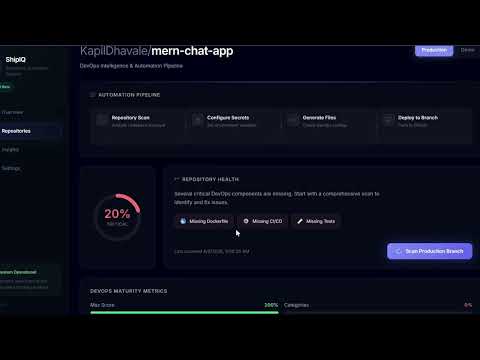
ShipIQ started from a pretty common problem:
Most repositories are not actually production-ready.
They might run locally, but they usually miss the boring infrastructure work that becomes painful later — Dockerfiles, CI/CD pipelines, deployment visibility, testing workflows, environment management, and monitoring.
Setting all of that up manually takes time and DevOps experience that many small teams simply don't have yet.
So instead of expecting developers to configure everything themselves, I built a system that analyzes repositories and automates the missing DevOps setup.
The problem
As projects grow, infrastructure complexity grows with them.
Teams often struggle with:
- missing CI/CD pipelines
- inconsistent deployments
- no Docker support
- poor deployment visibility
- insecure credential handling
- manual debugging workflows
- fragmented tooling
Most automation platforms either target massive enterprise systems or rely heavily on slow and inconsistent LLM generation.
I wanted something faster, deterministic, and practical.
What we built
- Repository intelligence engine — scans repositories and detects missing DevOps components automatically.
- Template-based artifact generation — creates Dockerfiles, GitHub Actions workflows, test scaffolds, and documentation.
- GitHub App authentication — secure multi-repository access without Personal Access Tokens.
- Real-time CI/CD monitoring — deployment stages tracked using GitHub Actions webhooks and n8n.
- Failure classification engine — parses workflow logs and annotations to identify exact deployment failure points.
- Intelligent retry workflows — retryable failures automatically trigger recovery workflows.
The architecture
ShipIQ is built around a modular automation pipeline:
Repository Scan
    ↓
Gap Detection
    ↓
Template Matching
    ↓
Artifact Generation
    ↓
Validation
    ↓
Pull Request Creation
    ↓
GitHub Actions Execution
    ↓
Webhook Tracking + Failure Classification
The platform integrates directly with GitHub Apps instead of PAT-based authentication, which makes multi-repository scaling significantly cleaner and safer.
Decisions worth calling out
- GitHub Apps over PATs — installation tokens are temporary, repo-scoped, and significantly safer than long-lived access tokens.
- Template-based generation over LLM-only generation — generation latency dropped from ~90–120 seconds to ~3–4 seconds while improving output consistency.
- Workflow-stage extraction using annotations — GitHub Actions only exposes workflow-level state, so I added custom stage markers to reconstruct deployment progress in real time.
- Webhook-driven architecture — n8n workflows handle deployment lifecycle orchestration asynchronously without blocking backend operations.
Trade-offs I made
I intentionally avoided fully autonomous code generation because deterministic infrastructure templates are much easier to validate and debug.
I also kept Kubernetes and Terraform support out of the initial release. Those systems add significant orchestration complexity, and I wanted the platform to stay focused on solving CI/CD onboarding first.
What it taught me
This project changed how I think about DevOps automation.
The difficult part usually isn't generating files — it's designing reliable workflows around validation, observability, permissions, and failure recovery.
A lot of infrastructure engineering is really about reducing operational uncertainty and making systems understandable under failure conditions.